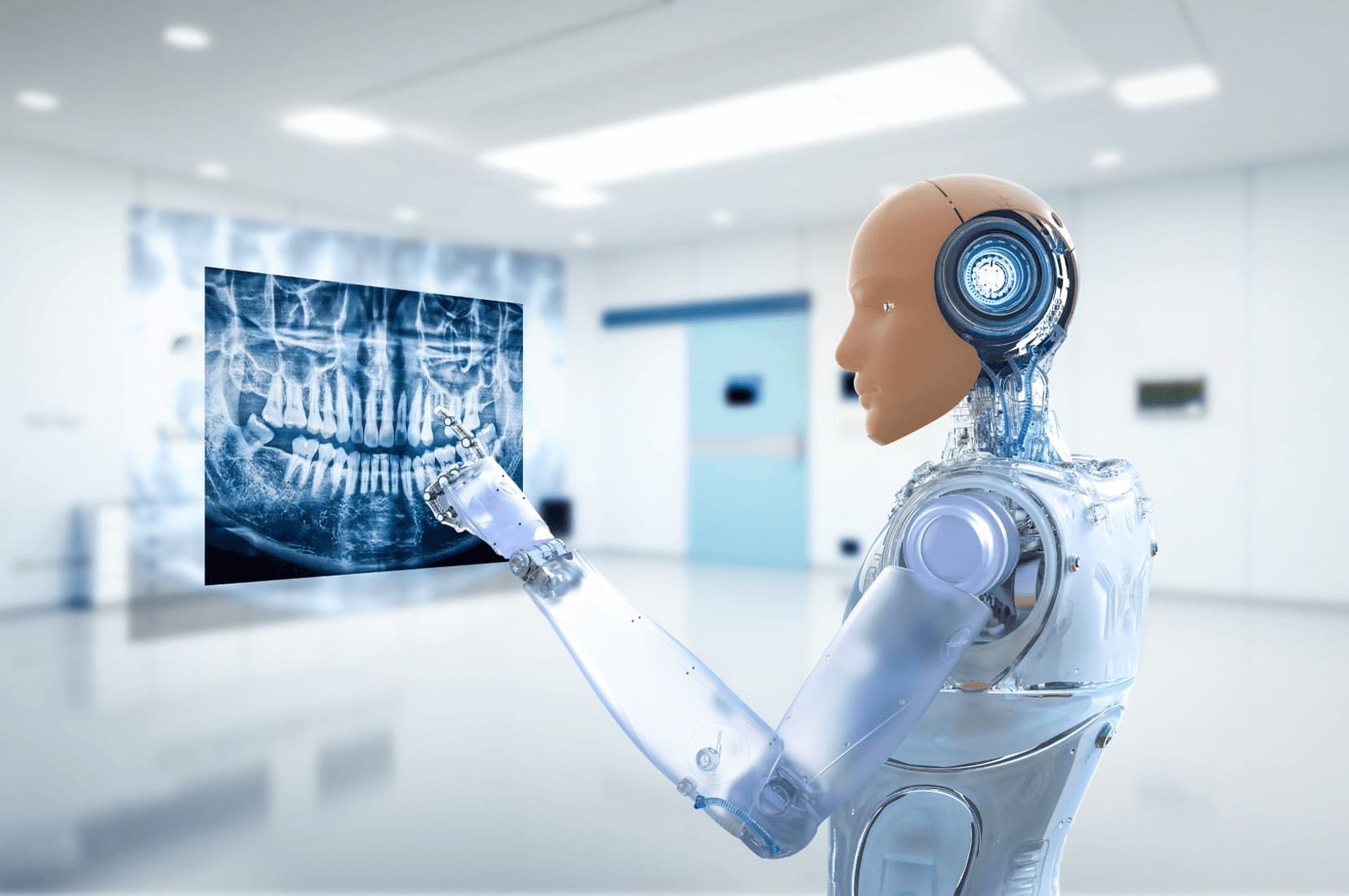
Artificial intelligence (AI) is rapidly transforming various industries, and dentistry is no exception. The integration of AI into dental practices promises to revolutionize clinical decisions, business operations, and patient experiences. This article explores the potential of AI in these key areas and how it can enhance the future of dental care.
AI in Clinical Decisions
AI’s ability to interpret and analyze medical images is one of its most immediate and impactful applications in dentistry. Through advanced computer vision technology, AI can examine periapical (PA) radiographs, accurately identifying and labeling teeth, detecting occlusal and interproximal decay, and pinpointing incipient lesions more precisely than the human eye.
For example, in Periodontics, AI can analyze periodontal disease progression by evaluating bone levels and identifying patterns in bone loss from radiographs. This capability not only improves diagnostic accuracy but also ensures consistency across multi-practice models. By standardizing diagnoses and treatment plans, AI reduces the subjectivity often present in clinical assessments, thereby building patient trust and ensuring uniformity in treatment recommendations.
Enhancing Treatment Planning
Beyond diagnostics, AI significantly enhances treatment planning. AI systems can automate the process by highlighting potential issues on radiographs and proposing treatment plans. This streamlines workflow and allows for continuous learning as the AI system refines its accuracy based on clinician feedback.
“Now, what I’m excited about is the automation of diagnosis and treatment planning. This will just speed things up essentially. You can look at the radiograph and with human feedback, you’re not going to accept what the machine’s going to give you, but it will highlight all the problems and you just have to click agreed, agreed, agreed. In that process of clicking agreed, it is actually learning from you. It’s like feedback. So it will become more robust and more accurate and more efficient over time.” – Dr. Tung Bui
For example, Oral and maxillofacial surgeons can benefit from AI in planning complex surgeries. AI algorithms can simulate surgical outcomes, allowing surgeons to visualize and plan interventions with greater precision. Clinicians can review AI-generated suggestions and agree or disagree with the findings, teaching the system to become more accurate over time. This feedback loop makes AI an invaluable tool in ensuring precise and efficient treatment planning.
Business Operations and Inventory Management
AI’s applications extend to business operations, notably in inventory management. Similar to its use in the grocery industry, AI can predict the demand for dental supplies, ensuring that practices are always well-stocked. This predictive capability is especially beneficial in practices with seasonal patient influxes, optimizing supply management and reducing waste.
“Inventory is big. So AI has been used in the grocery store industry to study the edge and flows of product movement and they can predict and order and make sure that there’s adequate supply in the grocery industry. So we can utilize the same thing in dentistry.” – Dr. Tung Bui
Fraud Detection and Human Resource Allocation
AI also enhances fraud detection and human resource allocation. By analyzing patterns and anomalies in financial transactions, AI can identify potential fraud, ensuring financial integrity within dental practices. Additionally, AI can optimize staff scheduling by reallocating resources based on real-time needs, minimizing operational disruptions, and enhancing efficiency.
Ethical Considerations and Challenges
Despite its numerous advantages, integrating AI in dentistry presents challenges. One significant concern is the potential for AI to impose rigid quality controls that might undermine clinical autonomy. AI systems might flag treatments as suboptimal based on strict criteria, potentially frustrating clinicians who understand the nuances of individual cases.
Moreover, the need for extensive data to train AI systems poses another challenge. Comprehensive patient follow-ups and recall appointments are essential for gathering robust data sets, which might require changes in current practice protocols.
“Patients who have a sense of distrust because, wow, this is a $5,000 treatment plan. I just went to another doctor for a second opinion and it was only $1,200. That causes a loss in trust overall. What the large business models are doing is they should be interested in AI because it can actually create some consistency with the diagnosis.” – Dr. Tung Bui
The Future of AI in Dentistry
The future of AI in dentistry is promising, with AI acting as a mentor or coach, guiding clinicians towards better decision-making. AI’s ability to analyze vast amounts of data and detect patterns that are not immediately apparent to humans holds immense potential for evidence-based dentistry.
For example, AI can improve endodontic outcomes by analyzing electronic dental records and identifying beneficial patterns, such as the impact of certain supplements on treatment success. Periodontists can use AI to track and predict periodontal disease progression, while oral and maxillofacial surgeons can leverage AI for precise surgical planning. This capability can revolutionize evidence-based practices in dental care.
Final thoughts…
The integration of AI in dentistry is set to transform clinical decisions, business operations, and patient care. From enhancing diagnostic accuracy and treatment planning to optimizing business operations and ensuring ethical practice, AI promises to revolutionize the field.
At Specialized Dental Partners, we are not only aware of these advancements but are at the forefront of integrating AI into our practices. Our network of knowledgeable and forward-thinking clinicians ensures that our partners benefit from the latest technological innovations. By joining our partnership, you become part of an elite group dedicated to advancing dental care through cutting-edge technology.
Despite the rise of AI, the human touch remains irreplaceable. Clinicians play a crucial role in quality control, providing the necessary context and personalized care that AI alone cannot offer. This human involvement ensures a continuous learning loop, where AI and clinicians work hand in hand to enhance patient outcomes.
For a deeper dive into how AI and other emerging technologies are shaping the future of dentistry, Listen to our partners talk about AI on our episode of Specialized “AI’s Role in Dentistry: Insights from Dr. Tung Bui” . Join us at Specialized Dental Partners and be part of this exciting journey towards the future of dental care.